

The history of the Academy of Music dates back to the year 1829 when the music school of the Croatian Music Institute began its work. Establishing the music school was one of the main founding goals at the time of the Institute’s establishment in 1827. Starting with only a few students and teachers of singing and violin, the school continuously grew. One of its main objectives was to train musicians to perform in the society's orchestra. By 1861, at the request of the founding society for the school to evolve into a conservatory, the Croatian Parliament granted permanent state support to achieve this goal. In 1876, the society's headquarters moved to a newly constructed building with a concert hall at 6 Gundulićeva Street. The music school, and later the conservatory and academy, continued to operate there (along with several other locations) until 2015 when it moved to its current, modernly equipped home with four concert halls at 12 Marshal Tito Square—today Republic of Croatia Square—enabling a new momentum in both educational and public activities.
The early history of music education in Zagreb was marked by the work of prominent figures in the musical life of the time, such as composer and conductor Juraj Wiesner-Morgenstern, composer Vatroslav Lisinski, theorist and musicologist Franjo Kuhač, and the versatile musician Ivan Zajc. During Zajc’s long tenure as director (1870–1908), state subsidies were significantly increased, which enabled the introduction of new subjects, the employment of highly qualified teaching staff, and the creation of conditions for the founding of a conservatory (in 1916) and, subsequently, the first higher education institution for training musicians in the then state—the Royal State Conservatory (in 1921), which changed its name to the Royal Academy of Music a year later. It is also worth mentioning the contributions of Vjekoslav Klaić, who, as a member of the board of the Croatian Music Institute at the turn of the 20th century, initiated the adoption of numerous foundational legal regulations, expanded the curriculum to include all orchestral instruments, strengthened the activities of the school symphony orchestra, raised the curriculum to the level of a professional repertoire, and organized collaborations with prominent international artists of the time—standards that the Academy of Music continues to uphold to this day.
The first rector of the newly established higher education institution was cellist Juro Tkalčić, who was soon succeeded by Fran Lhotka. The first administrative directors were Franjo Dugan, Vjekoslav Rosenberg Ružić, and Božidar Širola. The teachers of the main subjects at the higher education institution were granted the title of professor
Since the founding of the higher education institution in 1921, the Academy’s organizational structure has been based on departments (or, according to earlier terminology, divisions). Such structure has, from time to time, been called into question—even by long-serving professor and head of the institution, Ruben Radica. Despite the many structural changes that have occurred throughout history, they have not significantly altered the character of most study programs, which have, for the most part, maintained their original, recognizable identity and values—while continuously being updated and enriched with new content.
From 1923 until the end of the Second World War, studies at the higher education institution were organized into five departments: I. Piano and Organ, II. Orchestral Instruments, III. Voice, IV. Composition, and V. Music Pedagogy and Kapellmeister. The duration of the study varied across departments. In addition to higher education programs, both elementary and secondary music schools operated within the Academy at that time, providing a comprehensive vertical structure of music education. Due to a shortage of staff, secondary school teachers often assisted in teaching at the higher education level and even mentored graduating students, the first of whom received their degrees in the 1923/1924 academic year.
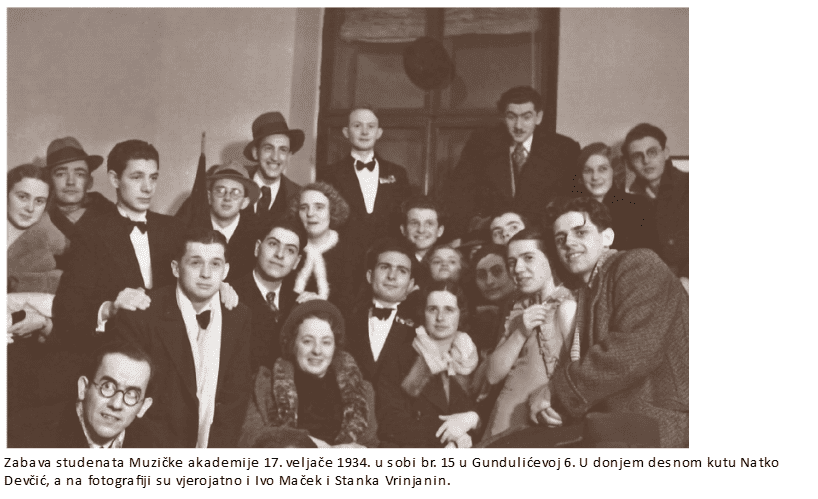
The next significant change in the Academy’s status occurred with the adoption of the Regulations on Music Schools in the Banovina of Croatia on May 15, 1940. According to these regulations, the then Academy of Music and Theatre Arts was elevated to the level of other university faculties, and its professors were classified as either full or associate professors. The following year, the institution was renamed the Croatian State Conservatory, and during the 1944/1945 academic year, docents joined the ranks of full and associate professors. After the Second World War, further organizational changes followed. In the 1951/1952 academic year, the elementary and secondary schools were separated from the higher education institution and became the Vatroslav Lisinski Music School, which continues to operate to this day.
At that time, the Academy’s structure comprised seven departments: I. Composition and Conducting, II. Voice, III. Piano and Organ, IV. String Instruments, V. Wind Instruments and Harp, VI. Historical and Theoretical Studies, and VII. Music Pedagogy, which consisted of a theoretical-pedagogical unit and three performance departments.
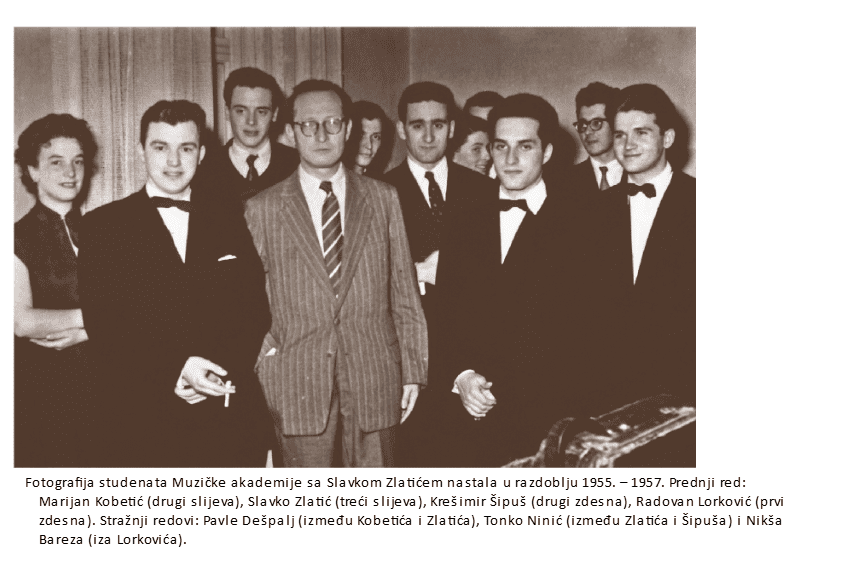
The Statutes of 1963 and 1966 once again changed the names of the departments: the VI. Department became the Department of Music History, the VII. became the Department of Music Theory and Pedagogy, and the performance sections within the latter were eliminated, which also affected the structure of the other departments. The performance- and pedagogically-oriented study programs were reintroduced, along with the Department of Orchestral Instruments. The growing demand for music teachers led to the introduction of two-year first-degree study programs, from which more ambitious students could transition to the four-year undergraduate program by passing a transfer exam. In 1965, a Department of Music Education for Teachers was opened, offering a two-year program following secondary school education. The late 1960s were marked by intensive activity in music scholarship: in 1967, the Institute of Musicology was founded to preserve and research Croatia’s musical heritage. Soon after, in the 1970/1971 academic year, a musicology degree program was launched, along with the publication of two musicological journals: Arti musices, focused on research in Croatian music, and the International Review of the Sociology and Aesthetics of Music.
The transition from the 1960s to the 1970s was marked by the broadening of the Academy's activities by establishing regional branches in Dubrovnik, Osijek, Rijeka, and Split. Their work significantly enriched the cultural life of their local communities, and the branches in Osijek and Split laid the foundation for the establishment of future independent music divisions within their respective academies of the arts. In the early 1970s, the Academy also briefly operated an IX. Department for Sound Engineering, launched in cooperation with Radio-Television Zagreb.
In 1977, a new law on higher education was passed at the republic level. All curricula and programs were revised, many new course contents were introduced, and a four-year study began at the newly established Department for Music Education Teachers. Additionally, the Academy’s internal structure was reorganized to include the following departments:
I. Composition and Theory of Music Department
II. Musicology and Music Journalism Department
III. Conducting Department
IV. Voice Department
V. Piano, Organ and Harp Department
VI. String Instruments and Guitar Department
VII. Wind Instruments Department
VIII. Music Education Department
That structure, with only minor modifications and additions, has been retained to this day. In the following decades, new instrumental study programs were introduced—percussion, saxophone, harpsichord, tambura, and euphonium—while the existing programs were continuously enriched and modernized.

The next major milestone in the history of the Music Academy occurred in 1979, when the institution became an integral part of the University of Zagreb—a development that, over the years, brought numerous new opportunities along with a few challenges. During this period, the oldest generation of the Academy’s teaching staff retired, and the faculty was gradually replenished with young professors of various profiles. Although this generational shift did not occur simultaneously across all departments, it nevertheless brought changes to teaching practices—less in formal structure and more in content and leadership approach. Student enrollment steadily increased, reaching its current level of five to six hundred students annually by the early 2000s with the introduction of the Bologna Process. The Academy’s public engagement became increasingly prominent, especially from 1983 onward, when student ensembles began performing regularly at the Vatroslav Lisinski Concert Hall. The vibrant performance activity of both students and faculty extended to various public venues, along with collaborative projects involving numerous associations, festivals, and cultural events.
In 1992, the Academy joined the European Association of Conservatoires (AEC), and after the Croatian War of Independence, its international cooperation significantly intensified. In 2007, the Office for International Cooperation was established, enabling extensive student, faculty, and staff exchanges through various mobility programs, most notably Erasmus+. The Academy has since signed an increasing number of cooperation agreements with foreign art schools and institutions, paving the way for numerous joint international projects such as EUphony, Medinea, CEMAN, and others. Tours by Academy ensembles abroad have also served to promote Croatian musical creativity internationally while offering students unforgettable formative experiences. Since 2009, collaboration with other art faculties within the University of Zagreb has grown stronger, leading to regular large-scale music-theatre productions—an initiative that has been part of the Academy’s activities since the beginning of its higher education work.
Throughout all those years, teaching was held in inadequate facilities, as the building of the Croatian Music Institute no longer met the Academy’s needs even in its early decades. By the beginning of the 21st century, the Academy operated across as many as seven locations—each equally unsuitable. Although the issue of the Academy’s infrastructural needs had been raised several times, it wasn’t until 2003 that the Academy administration signed an agreement with the City of Zagreb, granting the former Ferimport building to the Academy free of charge for a period of one hundred years. A public architectural competition followed, with Milan Šosterič’s design selected as the winner; his project was ultimately realized with certain modifications. The construction faced numerous complications and took nearly thirteen years to complete. On January 12, 2015, the Academy finally moved into its long-anticipated, purpose-built facility at 12 Republic of Croatia Square. Since then, that date has been celebrated annually as Academy of Music Day, marked by a ceremonial meeting of the Academy Council, the Dean’s Awards to outstanding students, employees, and distinguished retirees, as well as gift concerts. Students of the Academy of Music frequently receive additional recognitions from the Rector of the University of Zagreb, and in recent years also from other benefactors, such as the Rotary Club of Zagreb and the Mirjana Bohanec Vidović Award for the best graduating voice students. The new building, however, brought with it new challenges: extremely high maintenance costs, technical shortcomings, and insufficient funding to cover these needs. Given that an arts academy has limited opportunities to generate substantial independent revenue—combined with a chronic shortage of teaching staff and many external associates whose work is not always adequately and promptly funded—the issue of the system’s sustainability remains a constant concern. Nonetheless, the new building has enabled a range of new activities, many centered around its four beautiful concert halls. These spaces, especially following the series of earthquakes in 2020, have become vibrant and attractive centers of Zagreb’s academic and public life. The building has also provided the technical conditions necessary for modern teaching, conferences, professional recordings, and other previously unimaginable undertakings. None of these activities would be possible without the dedication of the staff of the Academy’s Production Office, established in 2014.
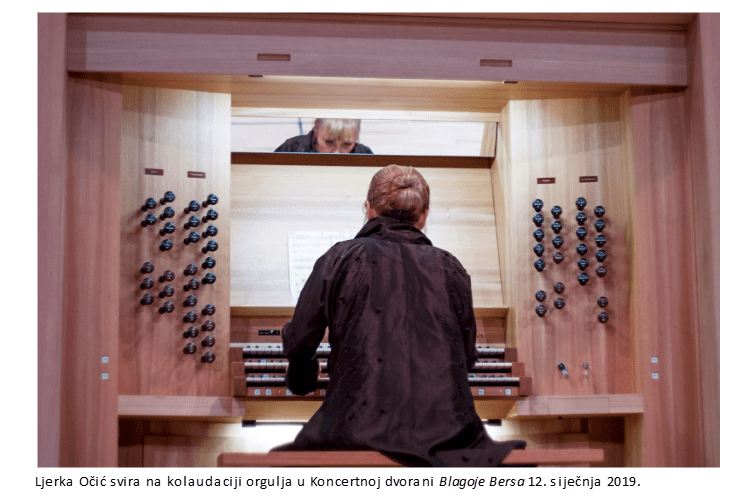
At the turn of the century, the need for postgraduate education increased, leading to the development of new postgraduate programs, evolving from the former scientific and artistic master's degrees and doctorates pursued outside of a structured doctoral program. In the early 21st century, the Bologna Process was also implemented at the Academy of Music. In 2005, the existing unified four- and five-year programs were replaced by separate undergraduate and graduate studies. However, considering the needs of the domestic labor market—particularly the education sector, which employs the majority of the Academy’s alumni and requires a master’s degree for teaching positions—a decision was made to reinstate unified study programs. As a result, integrated undergraduate and graduate programs have been offered across all teaching departments since 2013.